

What is Carbon Fiber? Properties and Applications
May 2, 2026
Expert Content
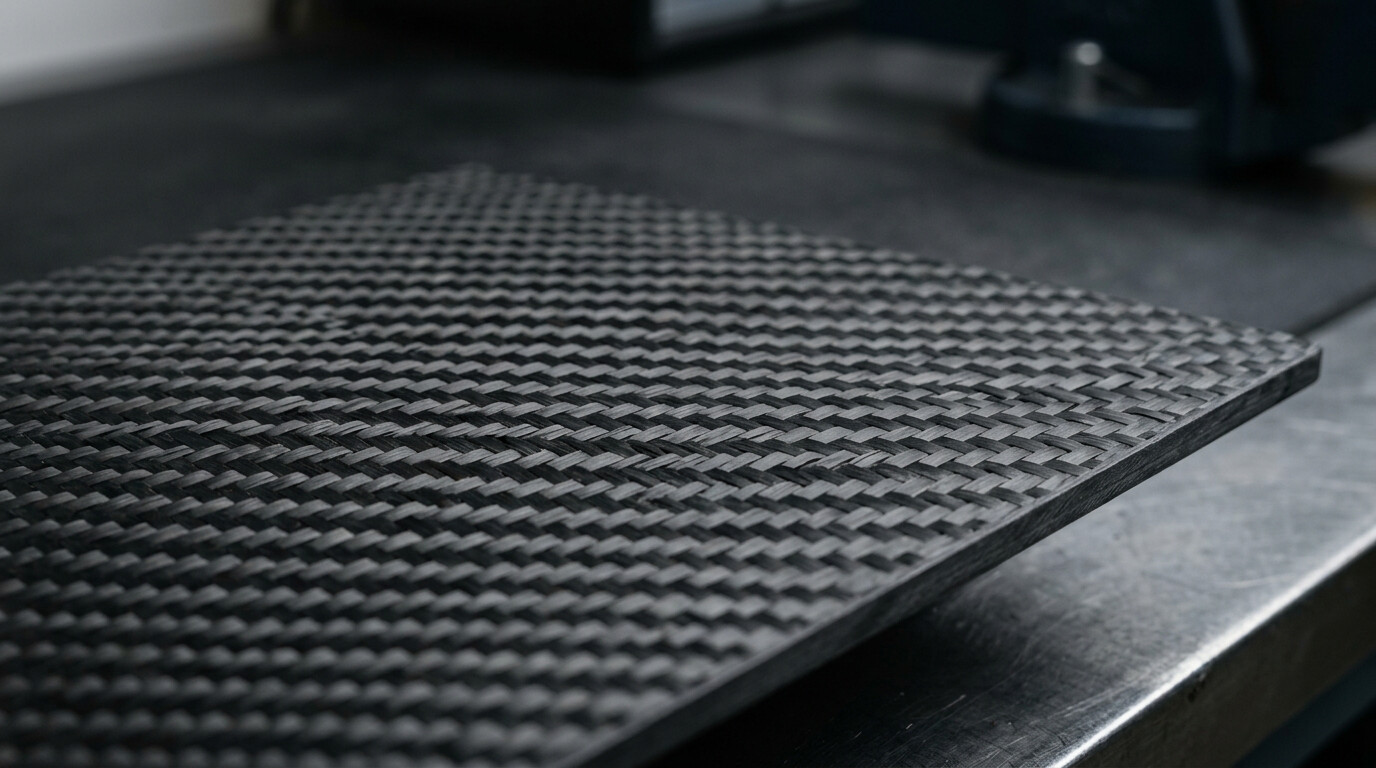
Carbon fiber is an advanced reinforcement material made of extremely thin filaments, roughly 5-10 microns in diameter, composed mostly of carbon atoms. When these filaments are combined with a resin system (typically epoxy), the result is a composite known in engineering as CFRP (Carbon Fiber Reinforced Polymer). The defining advantage of carbon fiber is its ability to deliver high strength at very low weight, offering a far more efficient strength-to-weight ratio than metals.
This guide covers the core properties of carbon fiber, how it is manufactured, the industries that rely on it, and the engineering decisions required to achieve the right result.
Key Properties of Carbon Fiber
The technical edge of carbon fiber comes not from a single trait but from a combination of them:
- High strength-to-weight ratio: Achieves the same strength with a much lighter structure.
- High stiffness: With proper laminate design it deflects minimally under load.
- Dimensional stability: A low thermal expansion coefficient keeps its shape across temperature changes.
- Corrosion resistance: Unlike metals it does not rust and withstands humid, chemical environments.
- Fatigue resistance: Provides a long service life under repeated loads.
Comparison with Steel and Aluminum
Comparing carbon fiber with common engineering materials makes its advantage concrete:
| Property | Carbon Fiber (CFRP) | Steel | Aluminum |
|---|---|---|---|
| Density (g/cm³) | 1.5 - 1.6 | 7.8 | 2.7 |
| Specific strength | Very high | Medium | Medium |
| Corrosion resistance | Excellent | Poor | Good |
| Design flexibility | High | Limited | Medium |
How is Carbon Fiber Produced?
Carbon fiber is usually produced by subjecting PAN (polyacrylonitrile) based precursor fibers to controlled thermal processes. The process broadly includes the following stages:
- Stabilization: Precursor fibers are heated to 200-300 °C in an oxygen environment to make the structure stable.
- Carbonization: At high temperature in an oxygen-free environment, non-carbon atoms are removed and the carbon chain densifies.
- Surface treatment and sizing: The fiber surface is prepared to improve adhesion to the resin.
- Weaving or unidirectional layup: Fibers are turned into fabric, tape or unidirectional plies.
Application Areas
Carbon fiber stands out wherever strength and low weight are simultaneously critical. In aerospace and defense it is used for fuselage panels and structural components, in automotive for performance parts and lightweighting, in sports equipment for bicycle frames and rackets, and in industry for robot arms, custom machine components and protective enclosures. In the energy sector, large structures such as wind turbine blades also benefit from composite technology.
An Engineering Approach for the Right Result
Material selection alone is not enough to obtain the expected performance from carbon fiber. The resin system, number and orientation of layers, surface quality expectations and the production process must all be evaluated together. A poor laminate design can produce a weak part even with the right material. For this reason the project, the material and the geometry must be addressed together.
Types and Grades of Carbon Fiber
Carbon fiber is not a single material but a family with different mechanical properties. By modulus it is classified as standard modulus, intermediate modulus and high modulus; high-modulus fibers are stiffer, while standard-modulus fibers generally behave tougher. Fibers are also named by tow size, such as 3K, 6K and 12K, where the number expresses the count of filaments in a tow in thousands. The weave form matters too: unidirectional plies carry load most efficiently along a single axis, while woven fabrics provide multi-axis strength and easier draping. The right grade is chosen according to the working direction of the part and the expected stiffness.
Frequently Asked Questions
Does carbon fiber rust? No; carbon fiber itself does not corrode, but galvanic-corrosion isolation must be applied at metal connection points. Is carbon fiber brittle? A properly designed laminate can show high impact resistance; brittleness is often the result of poor laminate design rather than the nature of the material. Is it suitable for every application? Because of its cost, glass-fiber reinforced alternatives may be more economical where weight and stiffness are not critical. For this reason the material decision should always be made by evaluating technical requirements and budget together.
MOE Kompozit manages engineering support, sample validation and the transition to series production together, according to project needs. This ensures the theoretical advantage of the material is consistently reflected in the real part on the field.
Request a Technical Quote for Your Composite Project
Let us align material choice, production route, quantity and lead time, then prepare a project-specific quote for your carbon fiber, FRP or fiberglass application.
Get Quote